Introduction
Good evening.
This is my first article written in English on this topic, and I hope it finds someone, somewhere, someday who actually needs it 😁. I have been working with since around 2018. One of the things that impressed me most about the language is its community — always willing to help newcomers. Many have found answers to their R-related questions on Stackoverflow, Mastodon, or the /rstats subreddit. But the community’s contribution doesn’t stop there: many members have gone as far as writing entire books about , making a demanding programming language far more accessible to the general public. A large number of these books are freely available online, the most well-known being R for Data Science, which was also the first R book I ever read. Beyond the community and the unlimited free material, dedicated groups have emerged to promote R among underrepresented communities in data science (e.g. R-ladies, among others), making the ecosystem genuinely inclusive.

In English, the collection of free material is overwhelming — for virtually every subfield, there is a book. As an example, the bookdown platform, which hosts one of the most extensive collections of free R books (over 1,500 titles), covers everything from R itself and its packages (data analysis, visualisation, forecasting) to highly specialised topics like Meta-analysis and Econometrics, and much more. But what about Greek-language content for R? In 2024, Hadley Wickham announced on Mastodon perhaps the best news for Greek R users: a Greek translation of R for Data Science now exists, titled Η R για την Επιστήμη Δεδομένων.

{bookdown} is a tool that allows R users to easily create documents and books. While the collection is primarily R-oriented, you may occasionally find unrelated titles or even books about Python.
That said, the translated RfDS is not the only contribution — other unsung heroes have also produced Greek-language R material over the years. To be included in this list, a resource must meet three criteria:
- It must be free
- It must be in Greek
- It must be accessible to the full range of R users
Books for R
In total, 8 books are freely available online. Four of them come from Kallipos, a Greek platform that hosts open-access academic textbooks across various scientific fields.
| Book title | Author(s) | Link |
|---|---|---|
| Η R για την Επιστήμη των Δεδομένων (2nd edition) |
Hadley Wickham Mine Çetinkaya-Rundel Garrett Grolemund P Togias (tr.) MT Pandi (tr.) |
Link |
| Πρόβλεψη (Αρχές και Πρακτική) | Hyndman, R.J. Athanasopoulos, G. |
Link |
| Εισαγωγή στην R Πρόχειρες σημειώσεις |
Φωκιανός, Κ. Χαραλάμπους, Χ. |
Link (direct download) |
| Προγραμματισμός σε R | Νικολαΐδης, Β. | Link |
| Εισαγωγή στον προγραμματισμό και στη στατιστική ανάλυση με R | Ντζούφρας, Ι. Καρλής, Δ. |
Link |
| Η επιστήμη των δεδομένων μέσα από τη γλώσσα R | Βερύκιος, Β. Καγκλής, Β. Σταυρόπουλος, Η. |
Link |
| Εισαγωγή στην επιχειρησιακή έρευνα και στον γραμμικό προγραμματισμό | Κουνέτας, Κ Χατζησταμούλου, Ν. |
Link |
| Εισαγωγή στην εκπαιδευτική και ψυχολογική μέτρηση με τη χρήση της R | Albano, A. Markos, A. (tr.) |
Link |
As is evident, the Greek-language options are limited compared to what is freely available in English. That said, there are some genuinely worthwhile choices, depending on the reader’s level and goals.
The best option available today — in my view — is the translated R for Data Science. It is the most complete book on the list, introducing the reader to a crucial mindset: data analysis is not just about producing a chart or a model — those are merely the final output. The book walks through the entire process that precedes that output in a clear and accessible way: collecting and loading data, transforming it into a shape ready for analysis. It is also worth noting that the book focuses on {tidyverse}, which is today the most widely used set of tools in R. It includes well-known packages such as {readr} (data loading), {dplyr} (data transformation), {tidyr} (data tidying) and {ggplot2} (visualisation). This is particularly relevant because several of the other books on this list are older and rely on what is known as base R.
From my own experience, starting with {tidyverse} is the better approach: there is an abundance of learning material available (documentation, blog posts, tutorials), strong support from both the community and Posit (formerly RStudio), and the syntax is more approachable. And if I still haven’t convinced you — many of the impressive charts you’ve seen floating around Twitter under #TidyTuesday, or appearing in newspapers and news networks (e.g. BBC), are made with {ggplot2}.
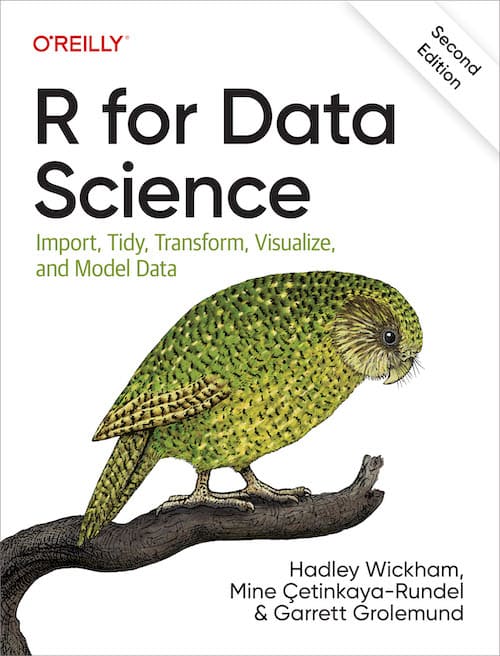
R for Data Science covers modern R through the {tidyverse} ecosystem. The first English edition was published in 2017, the second in 2023. The Greek translation was produced by Panagiotis Togias and Theodora Pandi.
My second pick — and my personal favourite until the RfDS translation appeared — is “Εισαγωγή στην R: Πρόχειρες σημειώσεις” (Introduction to R: Working Notes) by Fokianos and Charalambous. It combines theoretical notes with practical code examples across a wide range of statistical topics, from straightforward methods (t-tests) to more complex ones (cluster analysis). A particularly strong feature is that every chapter includes a hands-on R code example, which makes it excellent for statistics students — probably why I liked it so much.
The notes have two minor weaknesses. The first concerns depth: with nearly 300 pages covering an enormous range of topics, each chapter averages around 10 pages — enough for a first encounter, but not for genuine mastery. The authors made a deliberate choice to expose readers to a broad range of methodologies and spark their interest, leaving room for further exploration. I understand that decision, even if it sacrifices more thorough theoretical treatment. The second weakness is about the code: the notes were published in 2012 and are written in base R, without modern tools like the pipe operator %>%. This is not the authors’ fault — it is simply a sign of the times. For statistical tests, the functions used in the book are still standard and widely applicable today. For visualisation, however, I would steer clear of plot() and recommend investing time in {ggplot2} instead — Chapter 9 of Hadley’s book is a solid starting point.
A third option is “Πρόβλεψη (Αρχές και Πρακτική)” (Forecasting: Principles and Practice), the Greek translation of the well-known book by Hyndman and Athanasopoulos. It is a strong book, though not an introduction to R — it targets readers who are already comfortable with the language and want to explore time series theory, model identification, and forecasting. What sets it apart is that it consistently pairs theory with application: you are not just running commands, you are understanding why you are running them. It makes heavy use of the {tidyverts} suite (e.g. {fable}), the time series equivalent of {tidyverse}. The Greek translation is good and includes the corresponding Greek scientific terminology, which is a genuine bonus in a field where most sources are in English. Topics covered range from Box-Jenkins (ARIMA) models and exponential smoothing to dynamic regression and more advanced forecasting techniques.
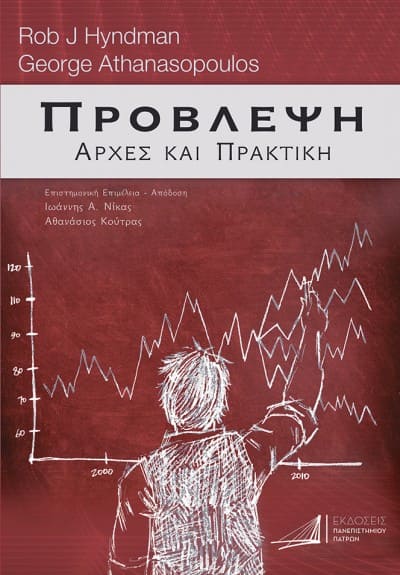
Hyndman, R.J., & Athanasopoulos, G. (2021) Forecasting: principles and practice, 3rd edition, OTexts: Melbourne, Australia. Greek edition link
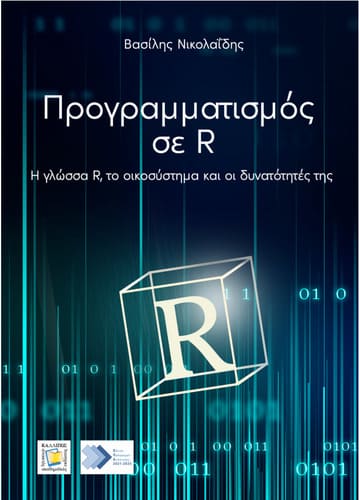
A book I had initially overlooked is “Προγραμματισμός σε R” (Programming in R) by Nikolaidis. It is closer in spirit to Hadley’s book, focusing on the modern version of the language. It begins by examining R’s quirks and data structures, moves on to core programming concepts (control flow, loops, functions), and closes with more advanced topics such as object-oriented programming in R and package development. It is an ambitious effort worth reading for anyone who wants to develop a deeper understanding of the language. Its main weakness is the limited coverage of statistical methods, which may disappoint readers who came to R primarily for data analysis. The relatively short length also leads to considerable overlap with Hadley’s book, making it a less obvious first choice now that the Greek translation of RfDS exists.
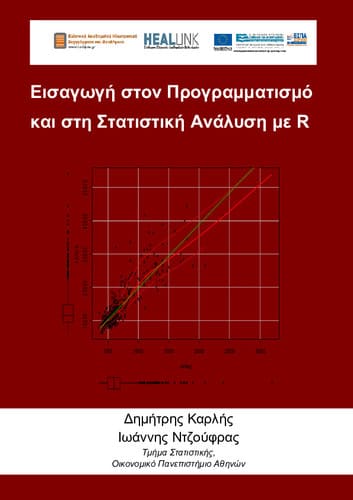
The fourth option, “Εισαγωγή στον προγραμματισμό και στη στατιστική ανάλυση με R” (Introduction to Programming and Statistical Analysis with R) by Ntzoufras and Karlis, is a book that left me conflicted. It had everything it needed to become my personal favourite, because it does not just show you commands — it teaches you to think programmatically, with meaningful emphasis on control flow, functions, and related concepts. That matters a lot when you want to build something non-trivial: a complex analysis pipeline, an R package, and so on. It earns extra credit for its chapters on basic statistical analysis. The downside is that it was published in 2015 and uses base R throughout, which keeps it off the top of my list.
The fifth option, “Η επιστήμη των δεδομένων μέσα από τη γλώσσα R” (Data Science through R), leans more into the notebook style and actively encourages the reader to start building their own projects. That is very important for anyone hoping to find a job in the field — I am still living on that hope 😄. Data analysis and data science are competitive fields for new graduates without prior experience, and a portfolio of personal projects makes a real difference. In my view, the book suits someone who already has some familiarity with R. Its main weakness is age (published in 2015), but setting that aside, its greatest strength is the sense of immediacy and motivation it gives you to actually build things.
The last two books on the list deal with specialised topics in which R is used as a supporting tool rather than the main focus. That does not make them unsuitable — it simply means they are better suited to more advanced users.
Video tutorials for R
Beyond books, I also searched for Greek-language R tutorials on YouTube. The available material is similarly limited. For now, I will highlight one option that stands out as the most comprehensive. In the video series by Christos Malliarakis, the fundamentals of R are covered first, followed by introductory examples in machine learning.
| Channel name | Link |
|---|---|
| Christos Malliarakis | Link |
Closing thoughts
The existence of Greek-language R resources is encouraging — both as a sign of the language’s growing popularity in Greece and as a step toward a more active local community. That said, they cannot serve as a replacement for the English-language material, only as a useful supplement.
In short: if you want to learn R, the best starting point is R for Data Science — the only book on this list that uses the most current packages. A worthwhile companion read is Nikolaidis’s Programming in R. If your specific goal is time series analysis, then Hyndman and Athanasopoulos’s Forecasting is the clear choice.
For the remaining books, my reservations are not about usefulness — they are useful — but about whether I would recommend them today. They rely primarily on base R, which is not inherently bad, but the language has evolved and more efficient tools now exist. Of these, the Fokianos–Charalambous notes stand out as an excellent introduction to statistical analysis, even if current practice is moving steadily toward {tidyverse}. Personally, beyond very basic statistical tests, I cannot recall the last time I saw someone using base R in any substantial capacity.
Happy reading. 📖
Citation
@online{2022,
  author = {, stesiam},
  title = {A Collection of Resources on {R} in {Greek}},
  date = {2022-10-23},
  url = {https://stesiam.com/posts/greek-material-for-r/},
  langid = {en}
}